Sunday, November 15, 2009

Seeking bathtub advice

Perhaps it is because my mother was English, but I have always had a love for baths and bathtubs. When I spent a month in England in '97, touring the great stately homes around the countryside, I was quite at home with all of the country hotels that only had bathtubs, no showers (my husband was not so pleased). To me, even the sight of a bathtub makes me feel instantly relaxed, and the bath has always been a place where I retreat when I feel any kind of physical or psychological pain.

By the time I went to college, I had already moved seven times because of my father's career. As a child, my sister and I always shared a 'kids bathroom' with a standard built in tub and shower. As long as I had a bathtub, I was not picky. A shower-only set up would have caused real angst for me.

fairmont-bungalow-bathroom

When I was a junior in college, I lived in the garage apartment of a family who had five little girls. In exchange for room and board, I tutored the children and assisted with the daily afternoon logistical challenge of managing five children at five different schools, with five different sets of afternoon activities. This was the first time I had a claw foot bathtub in my life. It was a real vintage tub, and I loved it (although, I hated taking showers in it). This is not a picture from the actual guest house in which I lived, but the set up was very similar - the tub was also the shower, and had a shower curtain exactly like this. It was unusual and a bit rare at the time, as whirlpool tubs were all the rage in the early 90s.

Now, it seems like every newly built or renovated bathroom I see has a freestanding bathtub. This is the tub that was in the Christmas Showhouse (interior design by Susan Ferrier, picture taken by me). When using a freestanding tub in a space like this, it truly looks like a sculpture, doesn't it?

Nate Berkus bathroom

Another freestanding tub picture that has recently caught my eye. Design by Nate Berkus.

Through this beautiful picture, I discovered a designer who is now one of my new favorites. So striking is this vignette that it was selected as the cover of Atlanta Homes & Lifestyles this spring . Would this space be nearly as beautiful with a built in tub? The answer is a resounding no. The freestanding tub allowed for the floor to ceiling antique mirror to be placed behind it, which is a large part of the charm of the space. Interior design by Amy Morris, image via Atlanta Homes and Lifestyles, photo credit Steve Pomberg.

kjoyce_br

This is one of my favorite pictures from Kerry Joyce's portfolio - I have admired this photo for years. The combination of the freestanding tub and the mirror strikes me as very European, yet also Californian too (Joyce is out of LA). Again, there is no way that this space could have been made so beautiful with a built in tub.

Sarah Richardson often uses freestanding tubs in her bathroom designs. They combine a vintage look with a modern feel.

When I think about all of the pictures in my files, this one comes to mind immediately as my 'dream bathroom'. I think it is because of the light fresh colors and the beautiful pattern on the floor. The tub is interesting to note - somewhat freestanding, yet it is also enclosed and has a ledge. I believe this is called a 'drop in' tub, as it has a finished rim and was made to drop into a custom surround. Image via House Beautiful, design by Jacqueline Derrey Segura, photo credit Simon Upton.

IMG_0152

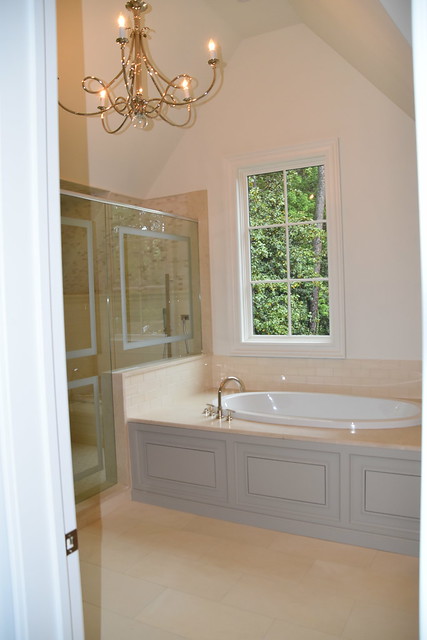
I also have some beautiful pictures of built in tubs in my files. This was an iphone photo I took at a tour of homes two years ago - it was truly one of the first tubs I have seen in a while of a new or newly renovated home with a tub that is not freestanding. This one is an undermount tub as it is mounted underneath the stone. Upon further reflection, this was a renovation of a bathroom and there probably wasn't space for a freestanding tub.

Image via Velvet & Linen - one of my all time favorite tub pictures. The shutters are so charming. So, it is definitely possible to have a beautiful arrangement of tub and window with a built in tub. Interior design by Kelly Harmon.

Grant Gibson, designer extraordinary and a blogger too - designed this master bathroom space. I love the look of a tub that appears to be set in a single piece of carved stone.

One of the most romantic images of a tub, from a post on sconces by Cote de Texas. Taking a bath in here would feel like being in a little hidden room.

This picture is also in my 'favorites' file - the tub tucked into the arched space, the sconces, and the window over the tub are wonderful elements, and work even better when all brought together in this vignette.

I have always thought that my dream bathroom would have a tub in an alcove, with an undermounted or drop in tub, but definitely not a standalone tub. Where would I put all of my magazines and books (the tub is the best place to read, and many a magazine and book have become casualties of my fondness for reading in the tub)? Are standalone tubs uncomfortable? Why am I now starting to turn my eye to freestanding tubs all of the sudden? I think it is because of the sheer sculptural beauty of a freestanding tub, the European charm of them, and the fact that they are now 'de rigueur' in Atlanta. I am starting to get persuaded.

So, readers, I would love your thoughts on bathtubs in this day and age. When you have the luxury of space and beautiful natural light (it might not be practical in a city apartment), what type of tub would you select? Why have we seen a resurgence of freestanding tubs over the past few years? For those of you who have a freestanding tub, do you like it? Is this one of those 'classic' design elements that will remain timeless because it represents historical design, or is it something that will be a sign of the times and outdated in 10 years? I would love to hear your opinions. I am not fixated on having jets in my tub or anything, I am more of a purist about just a simple tub. And yet, I have always thought that I would do a tub in an alcove like some of these pictures. Help!

Saturday, November 14, 2009

My Favorite Showhouse

I am a huge fan of the holidays, and the way that I start to get into the spirit of the holiday season is with the Atlanta Homes and Lifestyles Christmas House. Every year, a beautiful home is selected, the Southeast's most talented designers are enlisted to create spectacular spaces, and a showhouse is created that combines four of my favorite elements: beautiful interiors, amazing architecture, stunning art, and elegant holiday decor. I have been following the progress of the Christmas House through AH&L editor Clint Smith's tweets; I have also been reading the profiles of the designers on the AH&L newsletter and magazine. Finally, after months of preparation, the 2009 Christmas House is ready to open its doors on Saturday, November 14.

This week I had the great honor of getting a sneak preview of the 2009 Christmas House, located at 1795 West Wesley (in Atlanta). Bill Baker (whom I interviewed on the blog this summer) was the architectural designer behind the home, Mark Stevens of Southwick Real Estate was the builder, and over two dozen of the Southeast's finest designers were responsible for the interiors. Virtually everything was in place, in preparation for the opening night party. Like any home ready to open its doors to honored guests, there was a buzz of activity and last minute fluffing. It was a bit surreal to see some of the nations most revered designers doing last minute checks on their spaces; AH&L editor Clint Smith was on site making sure that everything was picture perfect for the home's premiere.

The 2009 Atlanta Homes & Lifestyles Christmas House. There were many busy people on site, preparing for opening day on Saturday, November 14.

I had heard buzz that this year's Christmas House is the most spectacular one yet, so my expectations were high. Without a doubt, my expectations were exceeded. My overall impression was of the beautiful flow of the spaces, which is both in part because of the architecture and the skill of the designers, who were hand picked by Clint Smith for the Christmas House.

The interiors of the home have a definite transitional flair; there were certainly elements of the traditional in every room, but the openness of the architecture and the beautiful quality of the light in the home lent itself to a neutral color palette (with quite a bit of soft gray), striking contemporary art, and a fresh interpretation of design that really reflects what people are liking now. Walking through the home was like walking through the pages of a magazine.

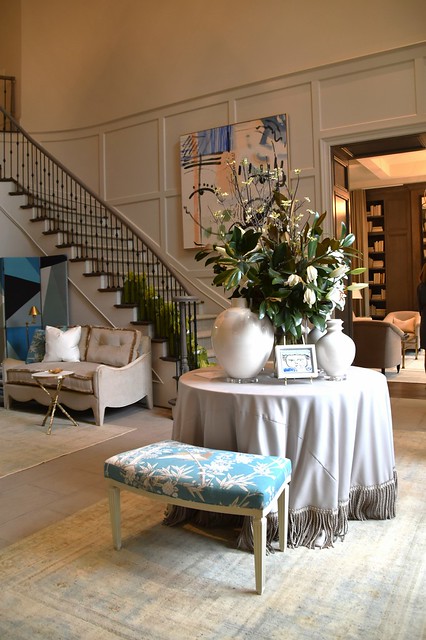
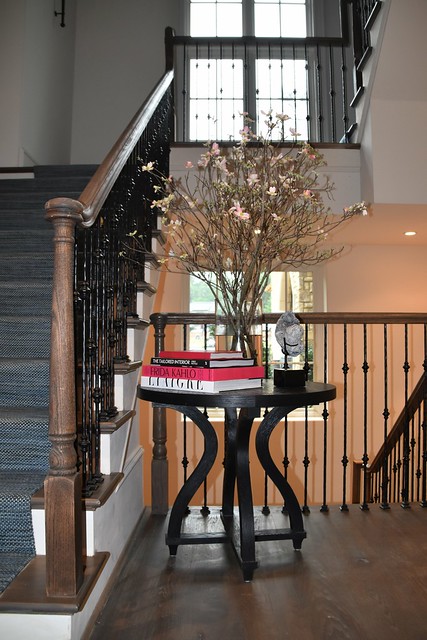
I always think that entries define the first impression of a home. Barbara Howard's entry (of Marshall Howard) set the perfect introduction to this home, with the branch arrangements adorned with green, gold and cream glass ornaments. A hint of the room can be seen in the mirrors lining the wall - note the antique lighting feature in the reflection. To see the space in its entirety is a marvel to behold...you can get a hint of the beauty in the first picture in this post. (All photos were taken by me).

Beyond the entry is the spectacular living room, with interior design by John Oetgen. As luck would have it, John was there when I arrived. He said the inspiration for the room was a house in the Hamptons, as the connection between the interiors and the garden is so strong in this home (there are three French doors in the living room that open to the back yard entertainment area and pool). John's intent was to create a space that is both elegant and casual; a four season room that would be enjoyed every day of the year. Here is a little peek at my favorite vignette in the room. I have a soft spot for a piano in a home; John Oetgen incorporated a piano into the living room with a beautiful gallery wall as the background. Most of the artwork is from John's personal collection, and the blue piece in the center was painted by John himself.

Next to the piano sits a clamshell perched on a garden seat, loaded with gifts; in the room of John's imagination, guests who play the piano at holiday gatherings will receive a special gift for their efforts.

A charming cherub sculpture with a whimsical Etro velvet cap. John is known for his touches of whimsy in every room he creates, and this scene made me smile.

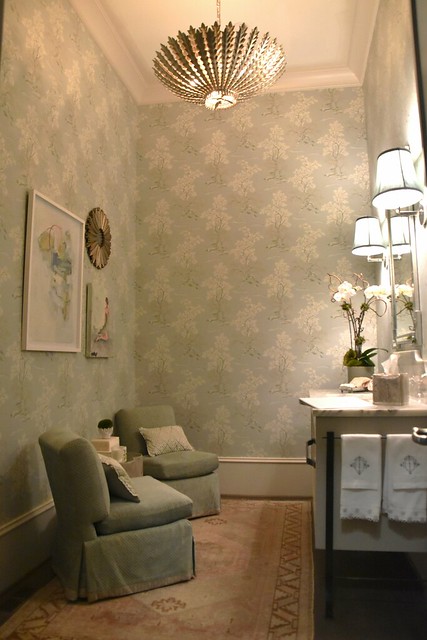
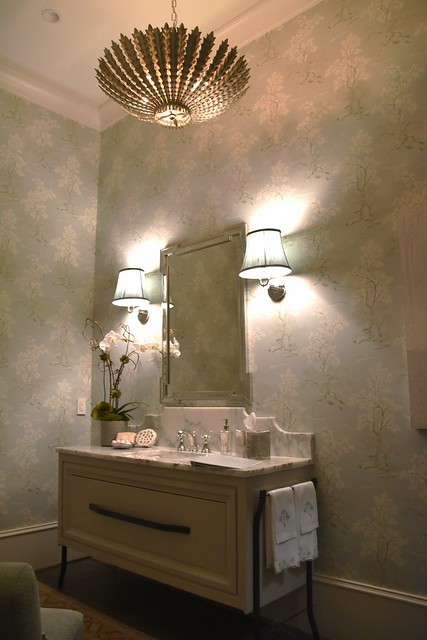
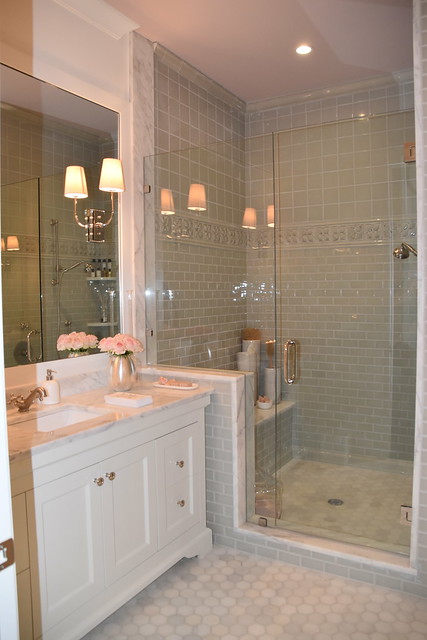
Another highlight of the home is the master bathroom created by noted designer Susan Ferrier of McAlpine Booth & Ferrier Interiors (she also designed the elegant and peaceful master bedroom). There was so much stunning light streaming into this space that I actually had a hard time capturing the room's beauty on camera.

The dining room, created by Sara Steinfeld, had a chic Hermès place setting on the table. Hermès of Paris is one of the sponsors of the Christmas House, and designed a room on the second floor of the house.

I found Barbara Heath's room (owner of Mercantile Atlanta) to be particularly beautiful. Barbara was putting last minute touches on the room when I saw it, and we had a difficult time picking out which vignette to feature from the room - there were so many beautiful elements in the space. Ultimately, we picked the 'magazine perspective' of the side table, and the mirrored bed. Barbara's store, Mercantile Atlanta, is well known for its one of a kind Murano glass lamps, as seen in this picture. (Make sure to peek into the closet in this room!)

Beth Webb did the design for the 'Artist Atelier', which really captured my imagination. In this small vignette from the space, I felt completely transported into the world of an artist refining his craft (and enjoying himself too - you will know what I mean if you have the opportunity to see the rest of the room!).

This is just a small glimpse into a few of the many amazing rooms in this year's Atlanta Homes & Lifestyles Christmas House. The roster of design talent reads like a 'who's who' in design:

Susan Ferrier, McAlpine, Booth & Ferrier Interiors
Barbara Heath, The Mercantile
Barbara Howard, Marshall Howard
Suzanne Kasler, Suzanne Kasler Interiors
John Oetgen, John Oetgen Design
Jared Paul, Jared Paul Interiors
Jimmy Stanton, Stanton Home Furnishings
Sara Steinfeld, Sara Steinfeld Ltd.
Courtney & Randy Tilinski, Bungalow Classic
Mark Williams and Niki Papadopoulos, Mark Williams Design Associates

For those of you who do not live in Atlanta, you can subscribe to Atlanta Homes & Lifestyles magazine, which will feature some of the rooms from the showhouse in a springtime edition of the magazine. For those of you who live in Atlanta - or within driving distance - I highly recommend a visit to the showhouse. It is a great weekend to come to Atlanta - Scott's Antique Market is going on, the weather is supposed to be beautiful, and the Atlanta Homes & Lifestyles Christmas House opens this Saturday, November 14, at 10 am. The Christmas House benefits the Alliance Children's Theater.

For more information on the Atlanta Homes and Lifestyles Christmas Showhouse, visit the website (email subscribers, click here).

Where: 1795 West Wesley Road Atlanta, GA 30327

Dates: Open for public tours Saturday, November 14 through Sunday, December 6.

When:

Wednesday – Friday: 10 a.m. – 4 p.m.
Saturday: 10 a.m. – 5 p.m.
Sunday: 1 – 5 p.m.
The House is closed on Mondays, Tuesdays and Thanksgiving Day

Tickets: $20 at the door, $18 in advance through woodruffcenter.org or alliancetheatre.org

Food & Gifts: Soups, salads, sandwiches and seasonal desserts will be for sale on site at Café Noel. Holiday gifts at the special shop by Boxwoods Gardens & Gifts, Inc.

Parking: Parking is not allowed at the Christmas House. However, there will be a continuous courtesy shuttle to and from the house from the IBM Office Complex at 4111 Northside Parkway NW, Atlanta 30327.

More information:

www.atlantachristmashouse.com

Finally, for an insiders perspective on the inspiration behind a room at the showhouse, check out designer Niki Papadopoulos' blog post on the room she designed with Mark Williams.

Tuesday, November 10, 2009

Looking back, and looking forward

Image via Veranda, photography by Tria Giovan

When I started my blog 2 1/2 years ago, I had no clue where it would take me. I saw it is a private scrap book, a place to organize my thoughts, a place to write. I remember very clearly registering for the blog, and trying to come up with a blog name; all of my top picks were taken. I looked around the room for inspiration, and my eye fell upon the latest issue of Veranda (June '07), which was open to an article called 'Fresh Palette' (picture above). I thought this was the perfect name for my new blog, as my intent was to write about art, architecture, and design. The palette reference was an obvious nod to art, as both the color selection that artists use, as well as the traditional board that artists use to place their paints. Fresh palette seemed an ideal way to describe the interiors I love as well; light, fresh, airy, serene.

Image via Veranda, photography by Tria Giovan, architecture by Norman Davenport Askins

In fact, the article from Veranda is one of my all time favorites, and the home in the article is on a cul-de-sac in Atlanta. I occasionally drive by the house just to appreciate its beauty.

When I actually started to write my blog, I chose 'Things That Inspire' for my blog header. It came to mind immediately, and it has turned into a better description of what I do on this blog; I like to write about the things that inspire me. I am usually very much on topic - after all, architecture, design, and art inspire me to no end - but occasionally I will slip in something else off topic that is a source of inspiration.

Now that I am venturing out a little bit more with my blog, I am finding that I no longer relate to the 'fresh palette' component of my blog url. When my blog was mentioned in Atlanta Homes and Lifestyles, it was identified as 'Fresh Palette' - an understandable assumption, given that it is in my blog url, however, in my mind the blog is 'Things That Inspire'.

Last week, when I attended the book launch party for Suzanne Kasler, I felt like I was 'coming out' as the person behind the blog. I finally met some of the other Atlanta bloggers; I met a lot of people in the Atlanta architecture and design community, many of whom I have written about at length; I met the president of Hickory Chair; I met Nancy Corzine's right hand man. After that party, and having to spell out the name of my blog url several times, I decided that it was time for me to register a web site for my blog.

And so, with this post, I am introducing my new blog address: http://www.thingsthatinspire.net/
I registered for the web site through blogger, so everything should be linked and hooked up automatically. No need to change any of your links; in fact, freshpalette is still working in the background, it's still there, but everything gets redirected to the new address. One casualty has been my blog list - it was totally wiped out in the transition. I am slowly but surely trying to recreate it, but it has been a challenge as it was something that developed naturally over the past two years.

I am looking forward to many more observations on the the things that inspire me, and hope you will stick around for the next chapter in my blog.

Sunday, November 8, 2009

One of my favorite things

People are often surprised to find out that I do not enjoy shopping for fabric, given my love for all things interior design related. I am fully aware of the beauty that a lovely fabric adds to a room, and think that the selection of the right fabrics with the right patterns, textures, and/or colors are essential elements in the design of a room. However, to me, shopping for fabric is like shopping for clothes - there are so many options, so many styles, my heart sinks every time I walk into a fabric showroom. I am definitely more of a fan of furniture.

I could look at furniture all day long. Sometimes I go to the Atlanta Design Center or Americas Mart for the sheer joy of looking at the most exquisite furniture you can imagine, all different styles and shapes and colors. To me, a well made piece of furniture is like a sculpture - so much care and consideration must be put into the scale and proportion in order for the furniture to 'work'. Then there is the matter of the finish, which can give a piece of furniture an entirely different look if it is created in a light or dark finish, a painted finish or stain.

233_NantucketSideTable

The Nantucket table by Rose Tarlow-Melrose House is, without a doubt, my one of my favorite pieces of furniture. I love the curves of the legs and finials counterbalanced with the straight beam in the midde, and the decorative elements carved into the top. After reading 'The Private House' by Rose Tarlow recently, I have an even greater appreciation for this beautiful piece of furniture. Quotes from Tarlow perfectly describes her approach towards the furniture in her line: "I don't reproduce furniture, I simply adapt designs until I find them pleasing". I highly recommend this charming book; it is a book that is mainly text, in some ways more of an autobiography. I loved reading Tarlow's observations on a life well led; she is keenly observant and has a sincere appreciation for quality over quantity, for slowly collecting, and for giving a room an emotional layer that goes a bit beyond just decorating.

The Nantucket table has gained a fair amount of press because of its placement on the set of 'Something's Gotta Give' - it was used in the main character's bedroom.

bolander_6

One of my all time favorite designers, Lars Bolander, used the Nantucket table in my favorite home from his portfolio.

rosetarlow_southernaccents_triagiovan

On rare occasions, I spot this table in my favorite design magazines. When I first saw this picture (image via Southern Accents, photo credit Tria Giovan), I noticed nothing but the Nantucket table. Now I am also appreciating some of the other details in the room - the contrast of the light finish of the table with the darkness of the built in cabinets. As a side note, I have recently noticed quite a few cabinets that are actually built into the wall - they look like furniture, but a recess in the wall has been created.

IMG_0061

Rose Tarlow is represented by Ainsworth-Noah in Atlanta (to the trade). I must admit that I purposely seek out this table every time I go into the showroom. Earlier this year, the showroom displayed the table next to a bed.

IMG_0123

Recently, it was paired with a sofa in a living room scene. Same lamp, though!

If I were to buy this table, I am not sure where I would put it. And, I wonder whether my dog Ben would knock this table over with his huge enthusiastic tail? He has decimated an antique table that belonged to my husband's grandmother as it has been knocked over so many times. This table, however, looks quite sturdy with its base with four legs. I keep thinking about Rose Tarlow's own recommendation in 'The Private House'- she is emphatic about buying what you love, and you will find a place for it. Does this philosophy work for you?

Please visit Rose Tarlow's newly relaunched web site for more inspiration. Also, for an excellent write up of the new location of Rose Tarlow's showroom in Los Angeles, see Velvet & Linen's post.

Wednesday, November 4, 2009

A 'Things That Inspire' Interview

A sneak peek of a vignette from the favorite room in my house

Recently, I found a wonderful new blog with a beautiful name: Verdigris Vie. The name was inspired by the rich green patina that forms on certain metals. As Vitania (the author) writes on her sidebar, "from new to old, the colour that represents beauty of change". Verdigris Vie is wonderful place to visit, and is full of inspiration for me.

I was thrilled when Vitania asked me to be a part of her 'Blog Anthology' series, in which she interviews the authors of her favorite blogs. Please visit Verdigris Grie to read the interview with me (email subscribers, click here to go to the interview). I tend to be a very private person, but the more I get to know my readers and the more I open myself up, the more I enjoy this blogging experience. I hope you enjoy the interview!

Tuesday, November 3, 2009

Nancy Corzine

When I first moved to Atlanta twelve years ago, I hired an interior design firm and was assigned to a young designer. Although I can't remember her name, I am still grateful to her for pushing me to be more tailored, and convincing me to focus on using high quality fabrics that will last for many years. The designer had recommended a beautiful fabric for my living room curtains, a soft delicate green silk with an abstract subtle floral pattern silk screened onto the fabric, and the most luxurious silk velvet for my sofa. Both of these fabrics were made by Nancy Corzine. As someone just becoming exposed to fine design, this was a new name for me, but it is a name I did not forget. Alas, my budget ran out and I did not order these beautiful fabrics, and I can honestly tell you that not a month goes by when I do not feel a small pang of regret, especially for the silk that would have been used for the curtains. I have never seen another fabric that is that exact shade of green, a shade I still love just as much today. I sometimes go to the showroom at the design center that carries Nancy Corzine fabrics, just to marvel at their beauty and texture, and think about how they would have looked so lovely in my living room.

Since my experience 12 years ago, Nancy Corzine is a name that I am always looking for in the magazines. Although Nancy is primarily known for her beautiful furniture, fabric, and lighting lines, she also creates exquisite rooms. This dining room, in her own Hamptons home, is truly one of my all time favorite dining rooms. The chinoiserie wallpaper, combined with the antique Italian starburst mirror, the beautiful sconces, the slipcovered chairs mixed with the wood chairs, the turned wood chandelier - sheer perfection. Image via First Dibs, photo credit Peter Vitale.

This room was in the August 2007 Veranda, from a Veranda showhouse in Florida. Nancy designed the living room, and its feminine beauty is truly a feast for the eyes. Most of the beautiful fabrics and furniture in the room are from Nancy's furniture line; the sconce is so beautiful with its elegant proportions in the sconce and shade. I love the mora clock that gives the room just the right touch. Image from Veranda, photography by Tria Giovan.

bookcover

When I heard that Nancy had just published a book, I was thrilled. As much as I admire her furniture and her design work, I feel as if I have not seen much of her body of work. Nancy's book has page after page of beautiful rooms that are designed by Nancy, many of which feature her refined furniture designs, and it was a pleasure to read. Nancy organized the book into rooms, and I learned so much about her approach and philosophy on rooms in a home, both interior rooms and outdoor rooms. Sprinkled throughout the book are Nancy's recommendations on key decisions in a home, such as choosing lighting; choosing fabrics; living with art; choosing a sofa; choosing a bed; and how to entertain outdoors. It is the words of wisdom and recommendations from Nancy that are the lasting impressions of this book; believe it or not, I have only just started to collect design books, and it is so gratifying to read the design philosophies of my favorite talents. For example, Nancy prefers clear glass in a mirror, because she thinks that it reflects the room and the person so much more beautifully.

Lest you think that Nancy's style is traditional based on the pictures above, nothing could be further from the truth. She is one of those rare designers whose taste and style seems to transcend description; the common denominator is elegant and luxurious simplicity, no matter what the style. In fact, on her web site, she has four different classifications, so broad is her range: contemporary, transitional, traditional, and casual. Her furniture, fabric, and her design represent all of these design aesthetics. What is fascinating is that she lives with all of these elements in her own life. Her Bridgehampton home is featured in the traditional section; the dining room I admire is from this house.

Untitled_101b

Her New York City apartment is very glamorous, and is quite contemporary in some areas, transitional in others (it was featured in the New York Social Diary). The master bedroom is featured in her book, and is lovely with the Nancy Corzine Prism bed (inspired by the Chrysler building) and exquisite Chagall hanging above the bed.

And her Los Angeles home, which is her base, is quite definitely contemporary. Nancy acknowledges that her taste generally leans towards contemporary design, although she is known for mixing the modern and the traditional.

Untitled_015

One of my favorite images from the book is from a home that Nancy designed in the Hamptons.

nc_miami

A charming blue and white scene that contrasts antique porcelain with a contemporary chandelier, interior design by Nancy Corzine. Photo credit Ken Hayden.

A guest room from a Hamptons home, designed by Nancy. Photo credit Ken Hayden.

LivingChaise

A glimpse into a more contemporary styled space from Nancy's portfolio.

nc_veranda

In my first month of blogging, I did a post on Nancy Corzine's beautiful Balthazar chandelier. Image via Veranda, photo credit Peter Vitale and Peter Murdock.

Another one of my favorite designers, Suzanne Kasler, frequently uses Nancy Corzine furniture in her designs. I recall reading an article where Suzanne declared that Nancy Corzine benches are her favorites (in this picture, Suzanne used a Nancy Corzine Louis XVI headboard and Louis XVI bench in a beautiful bedroom).

fortune-image4

Another home in which Kasler used the Nancy Corzine Louis XVI headboard in another beautiful bedroom.

Suzanne Kasler has the Nancy Corzine serpentine chests as her bedside tables in her own home.

Kasler_dr_corzinechairs

Suzanne Kasler's famous pink dining room features the most elegant Nancy Corzine chairs, upholstered in a Manuel Canovas fabric.

NancyCorzine

Nancy Corzine's new book 'Glamour at Home', is available right now. This post has just been a tiny glimpse into the vast variety of images in the book, and the interesting story of Nancy's design philosophy as it pertains to her furniture, fabric, and lighting lines, as well as her interior design approach. It is a wonderful addition to any collection of fine design books, and a book with real heart; Nancy, who lost her mother to Alzheimer's Disease several years ago, believes that in order to live a fulfilling life, it is important to give back. To that end, she devotes much of her time and financial resources to organizations such as the Alzheimer's Drug Discovery Foundation.

Nancy will be in Atlanta on November 5th for a special appearance and book signing at the Atlanta Design Center, as part of Veranda Magazine's 'The Art of Design' series. The book signing will take place in the Ainsworth Noah showroom, which represents her line. Normally ADAC is open only to the trade, but it is open to the public on this day with advance RSVP. For more information, please see the events page of ADAC by clicking here.

Nancy will be in Washington, DC next week on November 12 at the Washington Design Center. At 11 am she is speaking in the conference center; reservations are required. From 12-2 pm she will be in the Niermann Weeks showroom for a book signing. The Niermann Weeks DC showroom represents Nancy's furniture and fabrics line, and is on the 7th floor. For more information, visit the Washington Design Center website, or call 202-646-6100.

Monday, November 2, 2009

Inspirational Design: an interview with Joe Niermann of Niermann Weeks

I have always had a love for furniture and lighting, and am very aware of the role that quality construction, scale, and proportion play in creating a piece of furniture that will last for generations. One of my favorite lines of furniture and lighting is Niermann Weeks. Look closely at any top design magazine, and in every issue you will find at least one, and more often several pieces of Niermann Weeks furniture or lighting used in the designs of the most beautiful homes in America and around the world. It is a favorite of the top designers; the designs are truly beautiful, often based on the most exquisite antique furniture, but interpreted for modern needs and requirements. The lighting is truly exceptional - the designs are unique and creative, and often define any room in which they are installed. Just this weekend, it was announced that Niermann Weeks won the Luxist Readers' Choice Award in the category of best lighting, a well deserved honor.

Through my blog, I have become friends with Eleanor McKay, the CEO and C0-Founder of Niermann Weeks. She will often email me directly after a post of mine has particularly struck her, and we have had some lively discussions about trends in furniture and design in the 21st century. Eleanor's husband Joe Niermann is the Chairman and Co-founder of Niermann Weeks, and is also the principal designer for the company. Joe agreed to answer some questions for me as part of my inspirational design series.

joe_niermann

Joe Niermann of Niermann Weeks

How did you decide to pursue a career in furniture design?

clip_image002

A bank in Owatonna, Minnesota, designed by architect Louis Sullivan, was an inspiration for the young Joe Niermann. Image via Wikipedia.

Mostly it was serendipity. I had always been interested in design -- especially architecture. By age eight I was building models in my sandbox and reading everything I could find on architects and artists. I was born in Madison, Wisconsin, home of Frank Lloyd Wright, who became a real model for me. He had apprenticed under another renowned architect, Louis Sullivan, who designed a very famous bank in Owatonna, Minnesota where I grew up. Sullivan had also designed the building where my father worked and several local residences. By my middle teens I had read all of Wright's books and made pilgrimages to building by all the Prairie School architects in Minnesota and Wisconsin.

clip_image004

When I was twelve, I made drawing of a woman and child. It’s pencil-drawn, and I wanted to see if I could make a decent copy. When I was thirteen I was lucky enough to have my first one-man show at the Sullivan Bank in Owatonna, but I didn’t keep pen and ink drawings.

Sullivan's Auditorium in Chicago was also an early architectural inspiration for Joe (image via Wikipedia)

In my early twenties, I had to drop out of school to support myself. I moved to Chicago, America’s architectural capital, and ended up working in an insurance office only a few buildings away from Sullivan's Auditorium (pictured above). The staff there let me roam the building and really study its perfect construction. When I got married, Eleanor and I headed back to Madison, Wisconsin where she was completing her master's degree in history at the University of Wisconsin. I felt we had returned to the heartland of great architects.

In Wisconsin my furniture design work really had its beginning. Eleanor had been appointed as archival curator at the university’s history museum, where I was able to provide restoration services for some of the decorative arts in their collections. Restoration and conservation was then in its infancy. The museum curators and I pooled our skills and knowledge to develop this field. My secret fascination with famous forgers in history also helped explain some technical obstacles restoration must overcome. More importunately, studying original antiques with curators gave me an almost microscopic window into historical techniques of construction and finishing. When we moved to Memphis Tennessee with our two daughters, I planned to continue my restoration work.

However, my real profession began the moment I walked into the store of interior designer Rodgers Menzies to deliver a repair order. I felt like I was discovering another world. With the help of Rodgers, Jimmy Graham, and other generous designers, I quickly undertook a total immersion course into the history of interior design. Very quickly I was able to establish a designer clientele to restore and even recreate old finishes, and develop my own furniture designs. It didn't take long for me to realize that if I could restore something, I could make it. Memphis designers taught me so much and encouraged me to go full-time into the furniture design business. Their introductions opened the doors to our first showrooms in the Dallas and Atlanta Design Center. In 1978 Niermann Weeks, Inc. was born. NW moved to Annapolis, MD, in 1983, where Ann and Jim Lambeth welcomed us into their Washington, DC showroom. Then John Rosselli opened his New York showroom to Niermann Weeks, and soon we were represented in all the major design centers in North America.

What are your sources of inspiration?

The list is endless. It is impossible to list all the designers and styles that influence me, as my mind is like a sponge, storing visual images in a huge encyclopedia I can return to instantly I love Classical Greek and Roman art and architecture as much as Pre-Columbian If it is good design, it gets filed in my brain forever.

Once we spent a weekend at John Saladino's country house. At the end of the first day, John turned to me and said, " You have vacuum cleaner eyes". I think that says it all.

Do you have a particular style you favor?

I am particularly drawn to Continental European classical design from the late 17th century to the early 19th century.

What type of projects do you like to work on?

clip_image008

My favorite project is the next one! I never know what I will be called on to design. Primarily, Niermann Weeks makes residential furniture and lighting, although we are doing more and more work for hotels all over the world. The photo above shows our Iron and Crystal Ceiling Fixture hanging in the bridal suite of the newly renovated Jefferson Hotel in Washington, DC. Ceiling fixtures create harmonious shadow patterns that add to the beauty of the light

clip_image010

I particularly enjoy working closely with interior designers, to read their minds and to design what they need. In many instances they have only a nebulous idea of what they want. By sharing ideas and sketches, we evolve totally new designs based on the room size, color scheme, use of the room. I am often able to figure out what they don’t yet know they need. A great example of this is my relationship with Rodgers Menzies. He called me in 1997, desperate to finish a showhouse room on schedule and wanted a light fixture no one had ever seen before. I faxed him a quick sketch but it didn't convey the concept, so I made a full-sized model out of manila file folders to overnight him. This model showed him we had developed exactly what he needed. I gave that design the name Biarritz Ceiling Fixture, which has become one of our most popular designs.

clip_image012

When I’m designing, I start with quick sketches and then make a small model from cardboard and manila folders. This sketch on the right and the model beneath show the development of our Capuchine Chandelier.

clip_image014

The model lets me view my idea in three dimensions: height, width, and depth - something that even the best CAD can't do I make my first model very quickly, in minutes, and then adjust and refine it. When that model is OK, I go on to a full-size model that provides the templates for the artisan who makes the first prototype. Funnily, one of my full-size cardboard chair models met its demise when a client sat on it.

We still have a full-sized section of a custom chandelier for the Mirage Hotel’s Danny Gans Theatre in Las Vegas. The chandelier had to be 15 ft high by 21 ft wide, and was a custom mix of several of my standard designs. The CADs (computer aided design) just couldn’t convey the complexity this fixture required, so we overnighted the model. When the designers could actually see into the depth of the chandelier, then we got the go-ahead on construction.

clip_image016

The sectional mockup.

clip_image018

The installation.

Sadly, Danny Gans died unexpectedly this summer, so I expect the entire theatre will be soon be re-decorated for the next star.

What projects are you working on right now?

For the last few months I have been concentrating on a new collection of chandeliers and sconces, coming up with designs that I think the market needs. Because right now I am working without direct designer interaction, it's been a real challenge to design in a vacuum. Judging from past experience, after a new design is launched, I have to wait months and sometimes years for the reaction from my clients. Over the last 30 years I have developed a good track record but the market is always the final judge. Sometimes a favorite design of mine meets a brick wall and quietly disappears only to be revived years later. My design in 1990 for our Italian Chandelier didn't sell for the first five years. Today it's our biggest selling item, available on our QuickShip program and ordered in many interesting custom variations.

What is something that you should not skimp on when designing a new piece?

Basic proportion is key, then as Chanel said "the glory is in the details". Niermann Weeks is well known for our details and finishes but they are only as good as the basic frame they lie on. When I make my initial model of a new design, I remake it again and again until the proportion is "right". Then I develop the finish and details, working them over and over until the whole design is right. The finishing details become the final exterior skin, and the whole piece is only as good as its weakest design.

clip_image022clip_image024

In 1996 Palm Beach designer Allan Reyes showed me an antique Swedish chair in his store. Riffing on his original, I changed the proportions of the seat, the back, the height, the construction, and finish; the result was Niermann Weeks’s Gustavian Klismos Chair, one of our most popular chairs ever. Customers have ordered it in many different finishes, even in antiqued silver leaf.

clip_image026

clip_image028

Right now we’re doing an order of 24 in charcoal grey for a Mexican designer.

What trends are you seeing in your projects?

In my on-going seminars at design centers, I have been fortunate to talk with really enthusiastic designers. Their input has given me a whole new basis for my upcoming designs. Their clients’ number one request recently has been for ecologically friendly design. Because Niermann Weeks lives and manufactures in Maryland, one of the most environmentally sensitive areas in the US, our techniques and materials must be as environmentally "state of the art" as possible A real challenge is to keeping our customers informed about our continuing success in limiting our carbon footprint. We’re using water-based materials, farmed woods, recycled and recyclable materials, local artisans and resources, and always looking to make the earth a cleaner place.

clip_image030

Significant changes stylistically include an end to the over scaled glitz required by McMansions, which a friend calls Bastille Moderne . We are also seeing a renewed interest in the simple painted pieces first introduced by NW almost 30 years ago like the faux marble top on our Cascata Console.

I have always designed furniture to work scale-wise in our small house in the country and in our NYC pied-a-terre. If the proportions are perfect, these pieces can easily be "blown up" for public places or scaled down for more intimate spaces like powder rooms and bedrooms .

clip_image032clip_image034

Variations on the Mirabeau Dining Table (l); Our New York apartment (r)

clip_image036

Our youngest daughter and her partner are major devotees of the 1960s and are decorating their 1959 home in period pieces.

clip_image038

I guess I am too close to the 60's and have difficulty overcoming my basic prejudice about its designs, but to my surprise their project is developing into a beautiful home. I guess basic scale and proportion will always make the crucial difference, and I think we will see more interest in the 60's.

A fad you hope to never see again?

Pompous, overscaled glitz in any style is always the worst.

I would like to thank Joe for this wonderful interview, and Eleanor for making it happen. As I am such a fan of Niermann Weeks products (For the record - I am writing this post as a fan of Niermann Weeks products, and because of my admiration for Eleanor McKay and Joe Niermann. No gifts or services have been received in exchange for this post!), I couldn't resist including a few images of my favorite NW products in the context of rooms by some of my favorite designers.

NW Randolph Minor Bench, interior design by Jim Hawes of Caldwell-Beebe.

NW Mizner lantern, interior design by Liz Williams.

NW Lucien table, interior design by David Mitchell.

NW Gabrielle sofa. Architecture by William Hefner.

NW Italian chandelier, interior design by Anne Hepner

NW Circolo Bureauplat Major (to the right of fireplace). Interior design by Jim Hawes of Caldwell Beebe.

.

NW Swedish chandelier. Interior design by Jan Showers.

NW Baltic console. Interior design by Suzanne Kasler.

NW Baltic console, interior design by Eric Cohler.

NW Avignon chandelier. Interior design by Sally Steponkus.

NW Beaton mirror, my entry.

For more information on Niermann Weeks products, please visit their web page. Eleanor McKay also has a blog, and the latest entry is a particularly fascinating account of the launch of John Saladino's new fabric line at the Niermann Weeks New York showroom.

LinkWithin

Related Posts with Thumbnails